
Premium Photoshop Editing On Every Scan.
49¢ most slides. Expert Slide and Photo
Scanning Since 2002.
4,000 ppi Extra High Res Scanning.
We can make PRINTS from your Slides.
Personally Processed with care in Wisconsin.
 Home
Home Order Forms
Negative Film Scanning
We scan certain types of negative film and positive film strips. We do not scan 35mm color negatives or APS negatives. We do scan 120 medium-format negatives, Disc camera reels, and glass plate negatives and positives. If you are unsure what type of film you have, the images and descriptions below will help you identify it.
YES
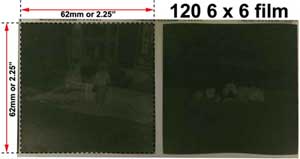
YES
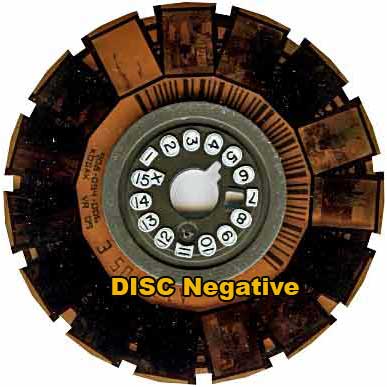
NO
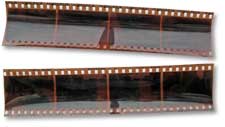
How Negative Film Scanning Works
When a camera exposes negative film, the image is recorded in reverse: areas that were bright in the original scene appear dark on the film, and dark areas appear light. With color negative film, the colors are also inverted — what was red in the scene appears cyan on the film, what was blue appears orange, and so on. This is what gives undeveloped color negatives their characteristic orange-brown appearance.
During scanning, we capture the negative image digitally and then use our editing workflow to invert the tones and correct the colors, producing a positive image that represents the original scene. Individual Photoshop color correction is applied to each scan just as we do with slide scanning, optimizing exposure, color balance, and contrast for that specific image.
We also scan glass plate negatives and positives — the historical predecessors of film, used primarily from the 1850s through the early 20th century.
120 Medium-Format Negatives
120 film is a roll film format that produces a significantly larger negative than 35mm. Where a 35mm frame measures approximately 24×36mm, a 120 medium-format frame can be 6×4.5cm, 6×6cm, 6×7cm, or 6×9cm depending on the camera. That larger film area captures substantially more image detail and produces exceptionally fine-grained scans.
Medium-format cameras were used extensively by professional photographers, portrait studios, and serious amateurs throughout the mid-to-late 20th century. Wedding photographers, commercial photographers, and photojournalists frequently used medium-format equipment. If your family has professional-quality portraits, formal photographs, or images taken by a photographer rather than with a consumer camera, there is a reasonable chance they were shot on medium-format film.
120 negatives typically come on a roll with a paper backing. The number of frames per roll depends on the image format: a 6×6 camera produces 12 frames per roll; a 6×4.5 camera produces 16 frames. Rolls should be handled by the edges to avoid fingerprints on the emulsion surface.
Disc Camera Negatives
Disc cameras were manufactured primarily by Kodak and others during the 1980s. Instead of a roll of film, they used a flat circular disc holding 15 tiny negative frames arranged around the perimeter. The camera advanced the disc one frame at a time as photographs were taken.
Disc film frames are very small — each frame measures approximately 8×10.5mm — making them among the most challenging film formats to scan well. The small frame size means that any scanner deficiency is magnified significantly in the output. Many services that claim to scan disc negatives produce mediocre results because of this difficulty. We apply the same individual editing attention to disc scans that we apply to all our work.
Disc cameras were popular with casual family photographers throughout the 1980s until they were discontinued in the early 1990s. If you have photographs from that era on disc film, they likely have not been seen since they were originally printed, and the originals may have deteriorated. Scanning now recovers what quality remains.
Glass Plate Negatives and Positives
Glass plate photography preceded roll film and was the dominant photographic medium from approximately the 1850s through the 1920s. Glass plates come in several types depending on era and process:
- Wet collodion plates (1850s–1880s) — required coating and exposure while still wet; fragile and historically significant
- Dry gelatin plates (1880s–1920s) — factory-made, more stable, produced negatives similar in quality to later film
- Lantern slides — glass positives designed for projection, often hand-colored
- Autochromes — early color glass positives using a dyed starch particle process
Glass plates require extremely careful handling — they are fragile, often irreplaceable, and in some cases more than a century old. We handle glass plates individually with cotton gloves and scan them flat on our equipment. If you have glass plates, contact us before shipping to discuss appropriate packing to prevent breakage in transit.
What We Do Not Scan
35mm Color Negatives
We specialize in slide scanning and do not offer 35mm color negative scanning. Color negative scanning requires a different workflow and scanner configuration than slide scanning. If you have 35mm color negatives, we recommend contacting a local professional photo lab or one of the services that specializes in negative scanning.
APS Negatives
APS (Advanced Photo System) negatives were used in consumer cameras from the mid-1990s until APS cameras were discontinued around 2004. An APS frame measures approximately 16.7×30.2mm — about half the size of a 35mm frame. We do not currently scan APS negatives. APS film also requires proprietary cartridge handling equipment to extract the film safely, as APS negatives were stored in sealed cartridges rather than on an open roll.