
 Home
Home Order Forms
120 & 620 Medium Format Film Scanning
What We Scan
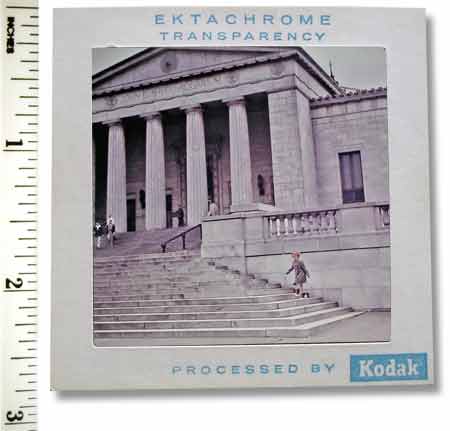
We scan 120 format film slides in carriers like the one shown above at $2 per slide. Each slide is scanned at 1200 ppi for excellent detail and resolution. These slides measure 2.75″ × 2.75″ on the outside of the holder. (Some photographers refer to these as 55mm slides.)
Important: We currently scan only 120 square format slides in holders (as pictured above). We do not scan loose medium format film strips or other large format films.
The Problem With Rolled Film Storage
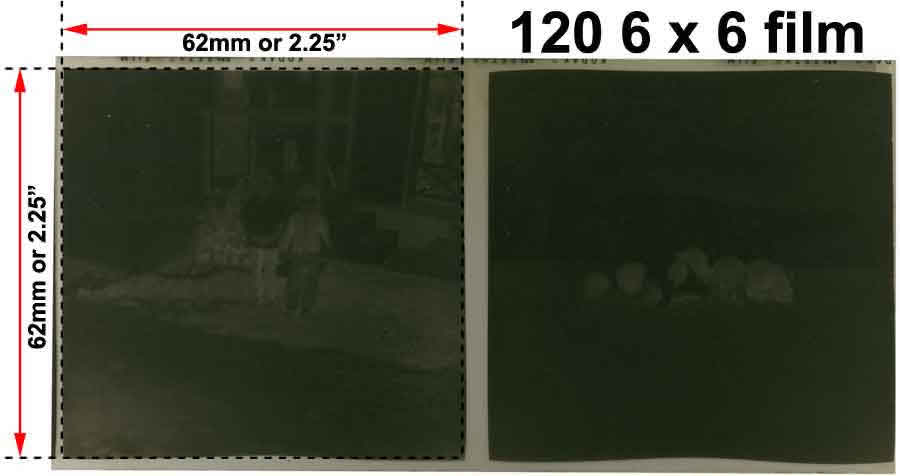
Medium Format Film Rolled Up
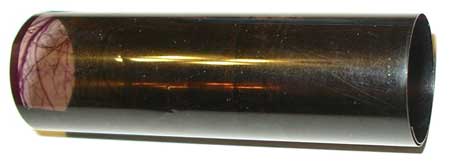
This Is What You Get When You Store Your Film Rolled Up.
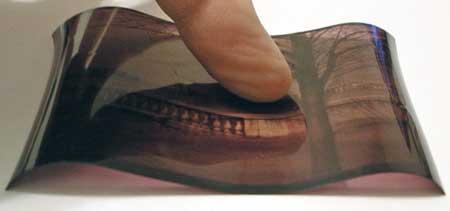
Medium format film stored rolled develops permanent waves and curls that make high-quality scanning extremely difficult. If your film has been stored rolled and shows significant curling, please understand we can only provide the best scan possible under those conditions. We cannot guarantee perfect results from severely curled film.
A Brief History: 120 & 620 Medium Format Film
The Kodak Brownie Revolution
Medium format film was created specifically for the Kodak Brownie cameras introduced in 1900-1901. These revolutionary cameras democratized photography with their simple, fixed-focus, "point and shoot" design featuring a single shutter speed. The "Brownie" name came from popular cartoon characters of the era depicting mischievous but good-hearted elves.

Walzflex TLR Medium Format 120 Camera
Understanding Medium Format
Medium format refers to 120 and 220 size roll film wound on spools rather than enclosed in cassettes like 35mm film. Nearly every major film manufacturer offered their emulsions in 120 format, with many also available in 220.
The key difference: 220 film was twice as long as 120, holding twice as many exposures on the same size spool. This was achieved by using only paper leaders on 220 film, while 120 film had paper backing running the full length of the roll.
Medium Format Film Formats

Brownie 120 Format Camera
Unlike 35mm film with its fixed 24×36mm format, 120 and 220 roll films could be used for several different frame sizes. The film width was fixed at 6cm, but the length varied depending on the camera. Common formats included:
Popular Medium Format Sizes
645 Format (6×4.5cm): 16 exposures per 120 roll. Offered portability similar to high-end 35mm SLRs.
6×6 Format (6×6cm): 12 exposures per 120 roll. Popular square format eliminated the need to rotate the camera between horizontal and vertical shots. Equivalent to 2¼″ × 2¼″ or approximately 56mm × 56mm.
6×7 Format (6×7cm): Enlarged perfectly to 8″ × 10″ paper, earning it the nickname "the ideal format." However, these cameras were heavy and typically required tripod use—better suited for studio work than portable photography.
6×9 Format (2¼″ × 3¼″): Also expressed as 6×9cm. Larger format for maximum detail.
The camera determined which format was captured on the 120 or 220 film. Some cameras featured interchangeable backs that could change the picture size.
Quality vs. Portability
If larger formats produce better images, why didn't everyone use 6×7 cameras? The answer lies in the trade-off between quality and portability. While 6×7 cameras delivered exceptional image quality, they were heavy beasts designed primarily for studio use. A 645 camera, by contrast, offered much of the quality advantage of medium format in a package as portable as a professional 35mm SLR. Taking 6×7 pictures without a tripod was nearly impossible.
The Story of 620 Film

Kodak Six-20 620 Format Camera
Kodak's Format Shift
In 1931, Kodak introduced the Six-20 camera along with 620 film. Around the same time, Kodak stopped manufacturing cameras that used 120 film. In the United Kingdom, Kodak Ltd. continued producing a few 620 models through the 1950s and 1960s. The Six-20 was classified as a "pinhole" camera with the viewfinder mounted on top.
620 film remained popular until the 1960s, when cartridge-loading Instamatic cameras simplified film loading and changed the amateur photography landscape. The Brownie Reflex 20 was likely the last 620 film camera manufactured by Kodak.
The End of 620 and the 120 Workaround
Kodak discontinued 620 film production in the 1990s, but photographers discovered a workaround: 120 film could be used in 620 cameras because the film itself was identical. The only difference was spool diameter—120 spools were slightly larger than 620 spools.
The solution required respooling in a darkroom: wind the 120 film off onto a spare 620 spool, then wind it back onto another 620 spool. This two-step process accounted for the film's start and end points, allowing continued use of vintage 620 cameras long after the format was officially discontinued.
Ready to Digitize Your Medium Format Slides?
Whether your slides came from a vintage Brownie camera or professional 6×6 equipment, we can preserve those memories in high-resolution digital format. Remember: if your film has been stored rolled with significant curling, please contact us before sending to discuss whether scanning will produce acceptable results.
Pricing: $2 per slide, scanned at 1200 ppi