Home
Home Order Forms
We Are Your Memory Care Specialists. Your Memories Are Safe With Us!
Your slides are fading even if they’re stored in a dry, humidity-controlled environment. Paper photos live in albums that are coming apart. You want your slides and photos digitized so everyone in the family can have a copy—and you can enjoy them on your big-screen TV.
You need a Memory Care Specialist. You need Affordable Scanning. You need us.
We’ve been doing this work since 2002 and our customers love the results. Imagine the peace of mind knowing your whole photo collection is safe and shareable. Duplicate discs are inexpensive—or make your own copies. Spread them around the family so a disaster in one place doesn’t mean losing everything. Insurance can’t replace your photos. They’re irreplaceable.
And no, you won’t get the same results everywhere. Many “big names” deliver only a basic scan. We edit every scan in Photoshop to correct fading and color shifts—often restoring the look you remember. Before you decide, at least try our ten free sample scans to see the difference.
Don’t be pressured by “sale every day” marketing. Even at advertised 60% off, our pricing is typically better—and our results speak for themselves. See our head-to-head examples starting on Page 1 of the comparisons.
Photographs and Memory Care — Why This Matters
For families with an elderly parent, grandparent, or loved one in a memory care facility, digitized photographs are not just a convenience. They are a meaningful tool for connection and comfort.
Reminiscence therapy — using familiar photographs to help people with dementia or cognitive decline reconnect with their personal history — is widely used in professional memory care settings. Studies consistently show that familiar images can reduce agitation, improve mood, and help patients feel oriented and connected even when other communication is difficult.
A slideshow of family photographs running on a large-screen TV can do things that conversation sometimes cannot. A photo of a long-ago family vacation, a wedding, a child’s birthday party — these images carry emotional memory that often survives long after other memory has faded. Seeing the face of a spouse from 50 years ago, or recognizing the family home, can produce moments of recognition and joy that matter deeply to both the patient and the family.
The Urgency of Digitizing Now
Color photographic slides from the 1950s through 1980s are actively deteriorating. The dyes that form the image are chemically unstable and break down over time regardless of storage conditions. The orange cast in old family prints is not how they originally looked — it is the cyan dye layer fading faster than the others. The original colors are still partially there but diminishing year by year.
Every year you wait, more image information is permanently lost. If a loved one is elderly or in memory care now, the time to digitize and create those slideshows is now — not after the collection has faded further or been lost in an estate transition.
What We Do That Others Don’t
Most large mail-in scanning services run slides through automated batch processing. Every slide gets the same settings regardless of the content. A slide with a blue color cast from age gets no correction. We work differently — every slide receives individual attention in Photoshop. Brightness, contrast, color balance, and fading are corrected for that specific image. For memory care purposes this matters enormously: a properly corrected scan — faces clear, colors natural, the scene alive — is far more likely to prompt recognition and emotional response than a faded, uncorrected batch scan.
How Families Use Digitized Slides for Memory Care
TV slideshow in a care facility room. A flash drive plugged into a modern television runs a continuous slideshow. Many care facilities actively encourage this. Staff often report that residents who have difficulty communicating verbally will point at or react to images of family members.
Family video calling. During a video call, a family member can share their screen and show digitized photos. This gives the call a focus and often prompts more engagement than a regular call.
Printed photo books. Digital files can be ordered into printed photo books. A physical book that a memory care resident can hold and turn pages in is a different kind of experience than a screen, and one that some patients respond to more naturally.
Sharing across the family. When slides are digitized, every family member can have a copy. Family stories attached to images can be documented while people who remember them are still alive to tell them.
Estate Slide Collections
We frequently receive slide collections from families going through an estate — boxes or carousels of slides that have sat in an attic for decades, never digitized, sometimes never even projected. Images no living person has seen in 40 years. Faces of relatives gone for decades. Places that no longer exist.
If you are sorting through a loved one’s belongings and find slides or photos, please don’t put them aside. The longer they wait, the more deteriorates. Contact us and we will help you figure out the simplest way to get them scanned.
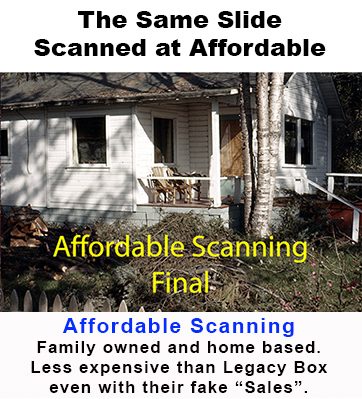
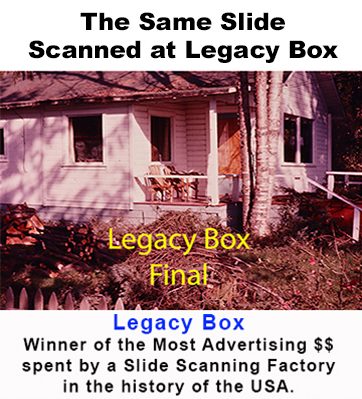
The Same Slide — Two Different Services
Our scan is on the left. Our largest competitor’s scan is on the right. Same original slide. No alterations after delivery.