
 Home
Home Order Forms
Slide Scanning Comparison — Page 3
Page 3 of our test using the same slides sent to Legacy Box and then scanned by us. This page contains some of the most striking failures in the entire series — including a desert slide returned with a heavy red cast, a 127 format plane slide with the larger film area cropped, and most notably, the Miami Seaquarium sign returned by Legacy Box reversed and mirrored so the text reads backwards. Every comparison uses the same original slide. Nothing has been altered after delivery.
Comparison 1: Desert Landscape — Red Color Cast
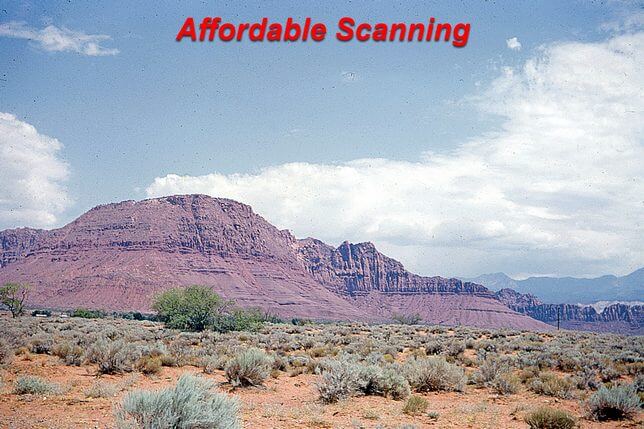
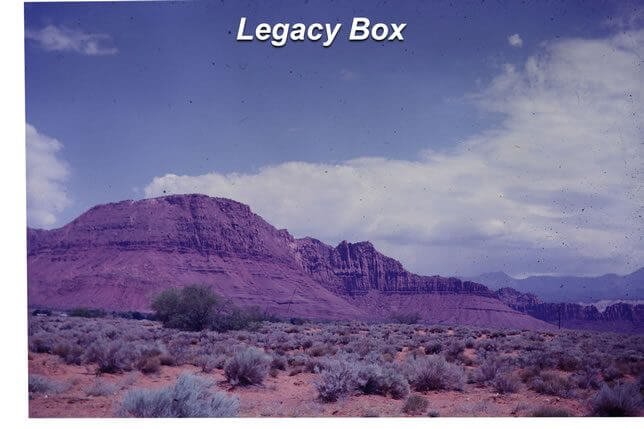
Desert landscapes are already warm in color — red rock, orange sand, dry brown vegetation — and a correct scan preserves those warm tones while keeping the sky a natural blue and the shadows cool enough to create contrast. The challenge for an uncorrected batch scan is that the warm tones of the landscape can trigger an exposure decision that pushes the color even further toward red-orange, losing the subtle differentiation between the rock colors, the sand, and the sky.
The Legacy Box scan (right) has a heavy red cast that oversaturates the already-warm desert tones, pushing the rocks toward an unnatural deep red and removing the cool-warm contrast that gives desert photography its visual interest. The sky reads as significantly more orange than blue. Our scan (left) preserves the natural range of warm desert tones while keeping the sky distinctly blue, maintaining the tonal separation that makes the landscape readable and visually accurate.
Comparison 2: Valley Scene — Color Cast and Shadow Detail
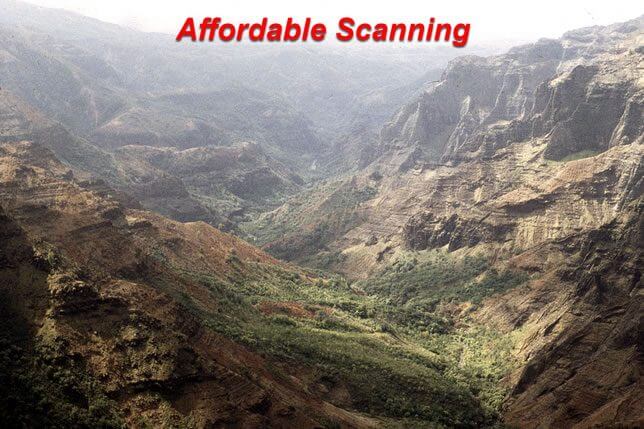
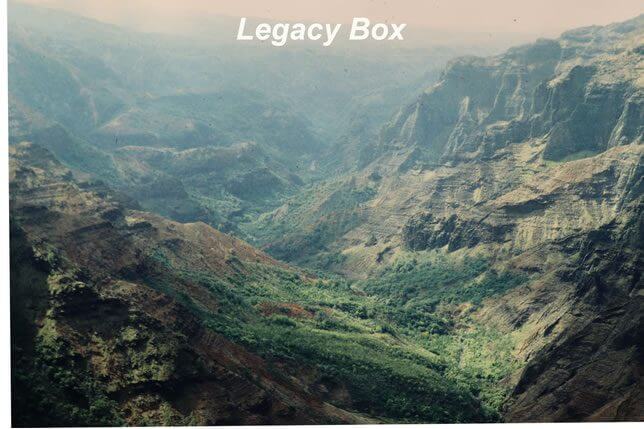
A valley scene typically includes a wide tonal range from bright sky and sunlit hillsides down to shadowed valley floor and tree cover. The depth of a valley — the sense of distance from foreground to background — depends heavily on correct color and tonal differentiation between layers. A color cast collapses that differentiation by shifting all tones in the same direction, making near and far elements appear closer in tone than they actually are.
Our scan (left) shows the valley with distinct tonal layers from the bright upper areas down to the darker valley floor, with color that differentiates the sky, hillsides, and vegetation. The Legacy Box scan (right) has a noticeable color cast that shifts the overall color balance and reduces the tonal separation between the landscape layers, giving the image a flatter appearance that loses some of the depth the original slide captured.
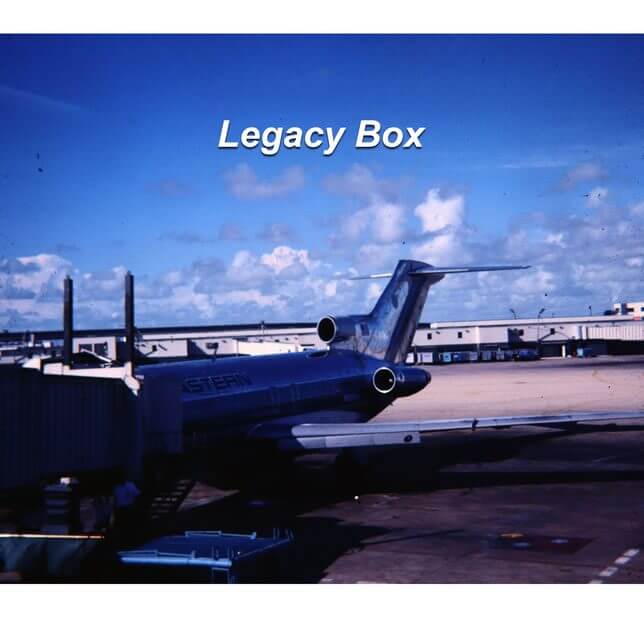
Comparison 3: Airplane — 127 Format Slide Cropped by Legacy Box
This slide was shot on 127 format film — a larger format than standard 35mm where the film area fills nearly the entire 2″×2″ mount. As with the Grand Canyon slide on page 5, Legacy Box equipment is set up for standard 35mm slides where the film sits well within the mount edges. When a 127 slide comes through, the larger film area extends closer to the mount edges than the scanner expects, and the result is cropping — part of the image is simply cut off.
The airplane in this slide is positioned within the frame in a way that makes cropping immediately obvious. Our scan (left) shows the full 127 format film area with the complete composition the photographer intended — the plane, the sky, and the full context of the shot. The Legacy Box scan (right) shows the characteristic cropped result of scanning a 127 slide on equipment calibrated for 35mm: portions of the frame are missing, and the composition is tighter than the original. Anyone who sends a 127 format slide to Legacy Box should expect this result.

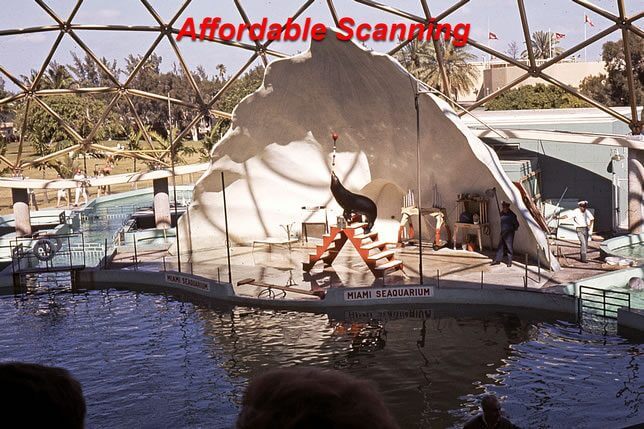
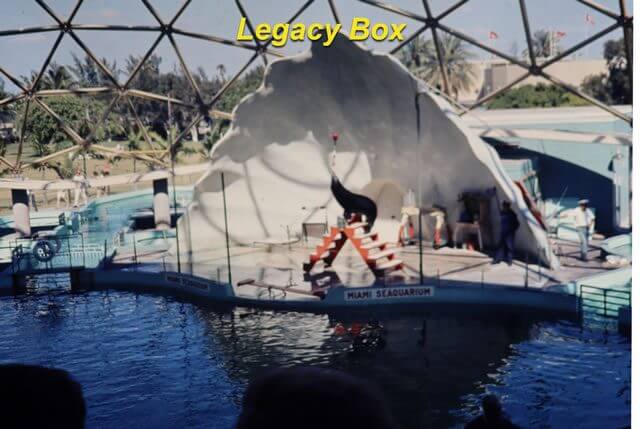
Comparison 4: Miami Seaquarium — Image Delivered Reversed and Mirrored
This comparison is the most unambiguous quality failure in our entire test series. The slide shows the Miami Seaquarium sign — a subject with clearly readable text. There is no interpretation required: either the text reads correctly left-to-right, or it does not.
The Legacy Box scan (right) delivers the image reversed and mirrored — the Seaquarium sign text reads backwards, as if you were looking at the slide from the wrong side through the emulsion rather than from the correct viewing side. This is not a color correction failure or a matter of subjective quality judgment. It is a fundamental orientation error that makes the delivered image unusable for its purpose. The only way this happens is if the slide was scanned emulsion-side up instead of emulsion-side down, or if the image was flipped during processing with no human review to catch it. Our scan (left) shows the sign reading correctly, as it appeared to the photographer and as any viewer would expect.
If this had been a slide of a family member rather than a sign, the reversal would be less immediately obvious — but the image would still be wrong. This is what can happen when no one looks at the results before shipping them back to the customer.
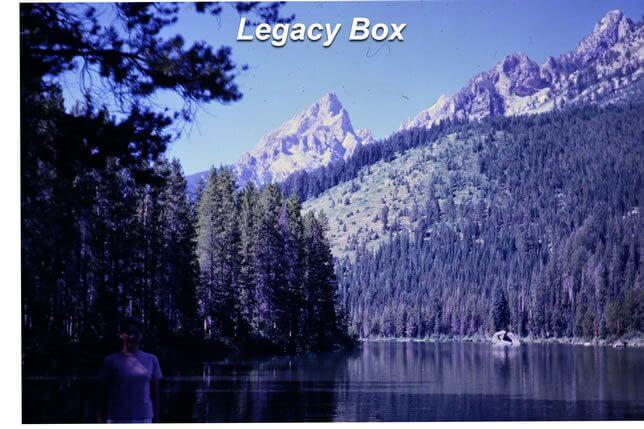
Comparison 5: Trees, Mountain & Lake — Color and Depth in a Complex Scene
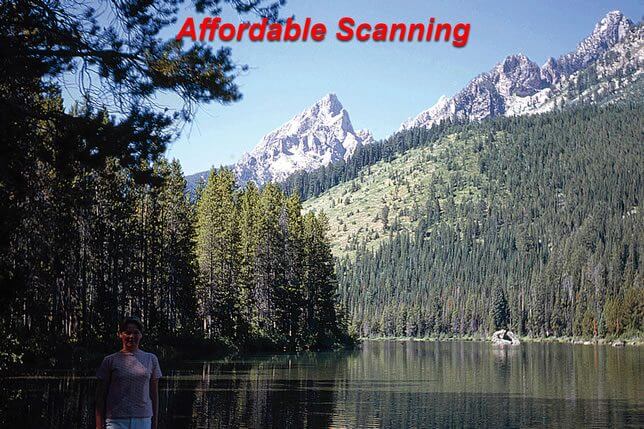
This panoramic scene combines three distinct elements — foreground trees, a middle-distance mountain, and what appears to be a lake or open valley — each with different color and tonal characteristics. Foreground trees are typically the darkest element with rich green foliage; the mountain reads as a mid-tone with its own color; the lake or open area reflects sky color and is typically the brightest part of the scene. A correct scan distinguishes all three and renders each in its own natural color range.
Our scan (left) shows the scene with rich green tree foliage in the foreground that is clearly distinct from the mountain tones behind it, and a lake or valley area that reflects the sky and creates genuine depth. The Legacy Box scan (right) has flatter tones throughout — the distinction between the tree foliage, the mountain, and the background is reduced, making the scene feel compressed and less vivid. The color palette is muted in the way that is characteristic of batch scanning without individual correction.
Legacybox™ is a trademark owned by AMB Media. We are not affiliated with this company. This page provides independent consumer information about scanning quality.